SVE Instruction List by Dougall Johnson
AESD (indexed): Multi-vector AES single round decryption
AESD { Zdn1.B-Zdn2.B }, { Zdn1.B-Zdn2.B }, Zm.Q[index] (SVE-AES2+NS (SSVE-AES+AES2
128-bit SVE
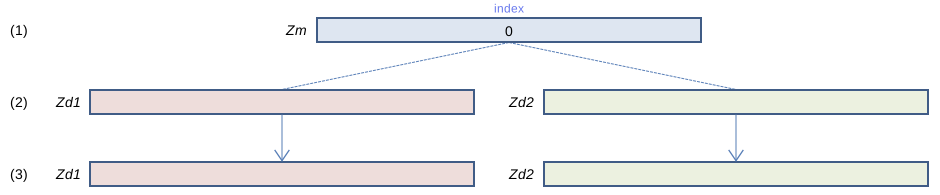
For each 128-bit block of Zd1–Zd2 (2), XOR with the indexed key block from (1), then apply AES inverse ShiftRows and inverse SubBytes, writing results to Zd1–Zd2 (3). The key index selects a 128-bit block within each 512-bit segment of (1).
256-bit SVE

For each 128-bit block of Zd1–Zd2 (2), XOR with the indexed key block from (1), then apply AES inverse ShiftRows and inverse SubBytes, writing results to Zd1–Zd2 (3). The key index selects a 128-bit block within each 512-bit segment of (1).
512-bit SVE

For each 128-bit block of Zd1–Zd2 (2), XOR with the indexed key block from (1), then apply AES inverse ShiftRows and inverse SubBytes, writing results to Zd1–Zd2 (3). The key index selects a 128-bit block within each 512-bit segment of (1).
Larger sizes
1024-bit SVE

For each 128-bit block of Zd1–Zd2 (2), XOR with the indexed key block from (1), then apply AES inverse ShiftRows and inverse SubBytes, writing results to Zd1–Zd2 (3). The key index selects a 128-bit block within each 512-bit segment of (1).
2048-bit SVE

For each 128-bit block of Zd1–Zd2 (2), XOR with the indexed key block from (1), then apply AES inverse ShiftRows and inverse SubBytes, writing results to Zd1–Zd2 (3). The key index selects a 128-bit block within each 512-bit segment of (1).
Report mistakes or give feedback
Inspired by and based on the x86/x64 SIMD Instruction List by Daytime.